लोक नीति विधि एवं अभिशासन उत्कृष्टता केंद्र
CENTRE OF EXCELLENCE IN PUBLIC POLICY LAW AND GOVERNANCE
भारतीय प्रौद्योगिकी संस्थान खड़गपुर
INDIAN INSTITUTE OF TECHNOLOGY KHARAGPUR
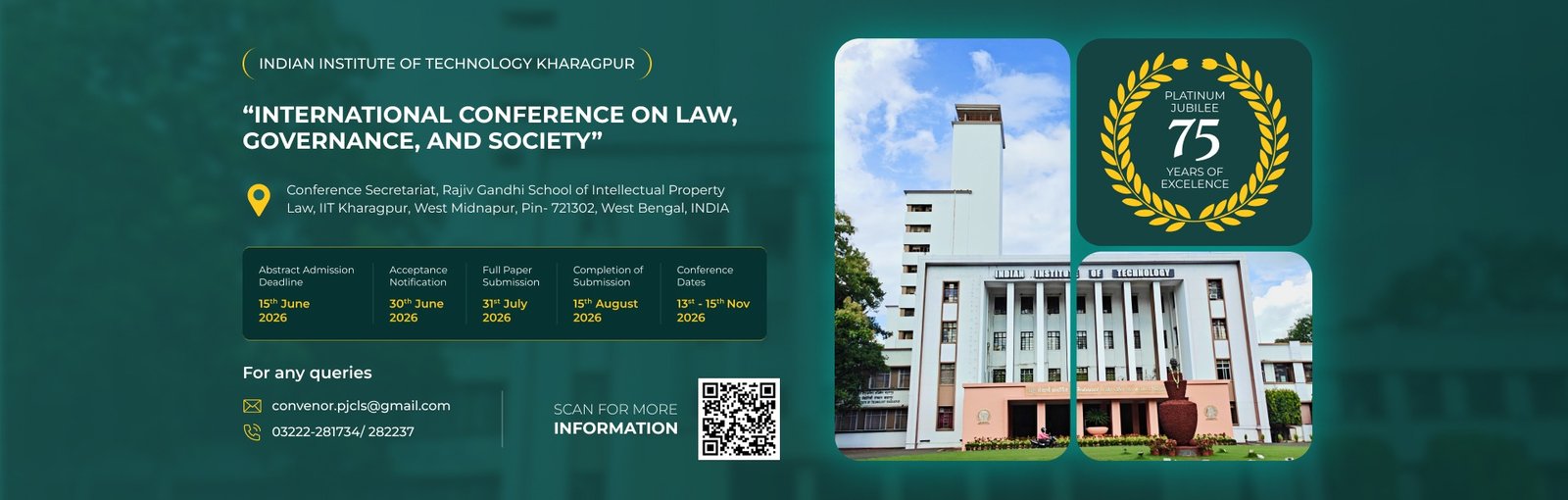
June 15, 2026
June 30, 2026
July 31, 2026
August 15, 2026
November 13-15, 2026
Established in 1951, the Indian Institute of Technology Kharagpur is India's first Indian Institute of Technology and a pioneering institution in higher education, research, and innovation. Known for its strong interdisciplinary ethos, IIT Kharagpur has consistently contributed to nation-building through excellence in science, technology, law, public policy, and management. Its academic ecosystem fosters critical inquiry, socially relevant research, and global engagement.
The Platinum Jubilee marks seventy-five years of institutional excellence, reflection, and transformation. This Conference is not merely a commemorative event but a forward-looking intellectual milestone that seeks to engage with the changing contours of law and governance in a rapidly evolving world. Situated at the intersection of tradition and innovation, the Platinum Jubilee Conference provides an opportunity to revisit foundational values while critically engaging with emerging global challenges such as technological disruption, environmental sustainability, and social justice. It symbolizes a renewed commitment to fostering interdisciplinary scholarship, inclusive dialogue, and policy-relevant research. By bringing together diverse voices from academia, industry, government, and civil society, the conference aims to shape future pathways for equitable, accountable, and transformative governance in India and beyond.
Law and governance are never neutral instruments. They are historically situated, politically contested, and socially embedded frameworks through which power is exercised, distributed, and challenged. As contemporary societies navigate accelerating transformations - technological disruption, climate emergency, democratic recession, and deepening inequality - the relationship between law, governance, and social life demands critical and interdisciplinary scrutiny.
This International Conference seeks to bring together scholars, practitioners, policymakers, and researchers to examine how legal and governance structures shape - and are shaped by - the societies they claim to serve. It interrogates the persistent gap between formal legal promises and lived realities, raising fundamental questions: Whose rights are protected? Whose voices are heard? Whose interests are excluded?
From constitutional frameworks and judicial institutions to informal norms, indigenous ecologies, and grassroots resistance, governance operates across multiple registers. The conference encourages engagement with emerging challenges such as algorithmic governance, environmental justice, postcolonial legal orders, gender justice, and rights of marginalized communities, alongside foundational concerns of legitimacy, accountability, and democratic participation.
Ultimately, this conference reimagines law and governance as dynamic and transformable spaces where society continually negotiates the terms of collective life.
The rapid integration of algorithmic systems into governance, markets, and everyday life has reshaped the relationship between rights, technology, and society. Law faces new challenges in aligning innovation with constitutional values, accountability, and social justice. AI-driven decision-making affects welfare, employment, and justice, raising concerns of privacy, transparency, and discrimination. Emerging issues of cognitive liberty and neuro-rights further complicate legal protections. Technological shifts in criminal justice, alongside digital economy concerns over data ownership and power, demand robust regulation. As algorithms risk deepening inequality and exclusion, especially for marginalized groups, this theme calls for interdisciplinary approaches to ensure technology upholds dignity, autonomy, and justice.
Sub-Themes:
In an era of ecological crisis, political fragmentation, and cultural homogenisation, pluralism, language rights, and cultural justice require urgent attention. The Anthropocene disproportionately affects indigenous and marginalized communities whose languages embody vital ecological knowledge. Their erosion leads to the loss of both cultural heritage and environmental wisdom. Reparation ecologies highlight the need to address dispossession of land, identity, and language, linking ecological repair with cultural restoration. Decentralisation empowers local communities, recognising their knowledge and identities while challenging colonial governance structures. This approach advances a radical pluralism that integrates environmental sustainability with social justice, affirming that justice for people and the planet are inseparable.
Sub-Themes:
Sustainable rural development is central to equitable growth, social stability, and economic resilience. Rural regions function as dynamic socio-ecological systems shaped by infrastructure, livelihoods, and governance. Technological change, climate uncertainty, and migration demand policies balancing growth with sustainability and justice. This theme examines integrated physical and digital infrastructure, livelihood diversification, and skill development. It highlights climate resilience, sustainable resource management, and community-based governance. Decentralised institutions like Panchayats play a key role in participatory governance and accountability. Emphasising inclusion, it addresses the needs of women and marginalized groups, fostering interdisciplinary approaches to build resilient, equitable, and future-ready rural societies.
Sub-Themes:
Bhartiya Gyan embodies a continuous civilizational knowledge system integrating ethics, law, governance, ecology, and technology. Rooted in lived traditions, it informs contemporary legal and policy challenges. Indigenous democratic practices and civilizational constitutionalism emphasized participation, consensus, and ethical governance grounded in dharma. Indian legal traditions historically embraced plurality through customary and community-based systems, now reflected in evolving jurisprudence on indigenous and environmental rights. The revival of Indian Knowledge Systems under NEP 2020 promotes interdisciplinary learning and integration with modern sciences. Traditional ecological knowledge supports sustainability, while technology enables preservation and innovation, ensuring its relevance in shaping future governance.
Sub-Themes:
The vision of Viksit Bharat calls for legal frameworks that align economic growth with constitutional values, social justice, and democratic accountability. Law must act as a transformative force shaping governance, markets, and innovation. Corporate governance should embrace stakeholder interests through ESG principles, ensuring accountability and labour protection. Strong constitutional rights, administrative fairness, and social welfare mechanisms are essential for transparent governance. Balancing innovation with public interest in intellectual property law is crucial, particularly in emerging technologies. Decentralised governance and urban-rural equity further strengthen democratic participation, making policy coherence, institutional reform, and ethical leadership vital for inclusive and sustainable development.
Sub-Themes:
The Conference invites original, unpublished research papers from academicians, researchers, practitioners, policymakers, and students on the above themes and related areas. All submissions should be made through https://forms.gle/CzecekMXCMATZ5Tn7
Selected high-quality papers will be considered for publication in an edited volume.
| Category | Fee (INR/USD) |
|---|---|
| Academicians / Professionals | Rs. 5,000 only |
| Research Scholars / Students | Rs. 2,000 only |
| International Participants | USD 150 |
Professor
Rajiv Gandhi School of Intellectual Property Law
IIT Kharagpur
Dean & Professor
Rajiv Gandhi School of Intellectual Property Law
IIT Kharagpur
Head & Associate Professor
Centre for Rural Development and Innovative Sustainable Technology
IIT Kharagpur
Assistant Professor
Department of Humanities & Social Sciences
IIT Kharagpur
Rajiv Gandhi School of Intellectual Property Law, IIT Kharagpur, West Midnapur, Pin- 721302, West Bengal, INDIA
convenor.pjcls@gmail.com
03222-281734 / 282237
13 - 15 November, 2026
IIT Kharagpur, West Bengal, India
3 Days
Rajiv Gandhi School of Intellectual Property Law, IIT Kharagpur (Platinum Jubilee)